- Succeed with Hennie
- Posts
- The hidden risk most “smart money” calculations ignore
The hidden risk most “smart money” calculations ignore
...and why it works right up until the month it ruins you.

Hennie Grove
February 06, 2026
Most people don’t take on debt because they’re reckless.
They do it because, at the moment they sign, everything looks stable.
The job feels secure (ish).
The income is steady (enough).
The bonus is expected.
The bank statement looks fine.
They can “afford the payment”. Or at least, that’s what the spreadsheet says for now.
So, the calculation feels reasonable.
“If nothing changes, this works.”
That single sentence hides the entire problem.
Because debt doesn’t ask whether something can work.
It quietly assumes nothing will change.
Debt is a risk amplifier pretending to be a math problem.
There’s a second group, though, that rarely gets spoken about honestly.
People who say and genuinely feel they didn’t have a choice.
Expenses ran ahead of income.
Life got more expensive.
Something had to give.
So debt became the “temporary” bridge…
…to eventual insanity.
The problem is that this bridge doesn’t stabilise anything.
It makes next month tighter.
Then the month after that worse.
Debt doesn’t solve a cash-flow gap.
It locks it in, and then continues to make it worse and worse.
The harsh reality is this:
If expenses outrun income, the only sustainable options are to
amputate some expenses aggressively
increase income (yes dear reader, get a second or third job if you must), or
do both – until money starts working for you instead of you working for money.
There is no clever workaround.
These are the hard yards.
And debt is what people use when they want to avoid them, only to end up making them even worse.
That assumption – that debt is helping – shows up in two very common patterns.
The first is optimism.
Everything looks stable, so the numbers must be fine.
The second is cleverness.
You’ve heard them all over Youtube and TikTok especially – barely a dime to their name yet giving out advice on what YOU should do.
Using one credit card to fund another.
Shuffling balances around.
Earning points, miles, or cashback while interest quietly compounds in the background.
It can feel sophisticated.
Almost like a financial shell game.
But people don’t build wealth from credit card points.
Banks do. They have teams of people whose job it is to understand behavioural blind spots AT SCALE. That’s why the system works so reliably in their favour. That’s why they can afford big buildings.
And sometimes the story goes a step further.
People would rather pay thousands in interest to a bank than a few hundred to the Taxman, so the debt on that car “must be fine”. Not sure who taught them math. That’s not tax efficiency. That’s self-deception.
They’ll keep an expensive car because, really, downgrading feels like moving backwards in their minds.
They’ll protect appearances while quietly putting their home, their sleep, their future, and their family under pressure. And then try and convince everyone how smart they really are.
Debt isn’t just a math problem.
That’s a behaviour problem.
And it’s not limited to low income people either – read on…
Debt is often sold as a smart decision dressed up in numbers.
Borrow at 5.
Invest at 10.
Pocket the difference.
On paper, it looks elegant. Genius even. Like an infinite money loop.
In real life, it turns every assumption in your world into a requirement.
Your income must stay where it is.
Your health must cooperate.
Your expenses must behave.
The economy must remain friendly.
Debt doesn’t just amplify returns.
It amplifies fragility.
Allow me to explain before banging your fist on the table.

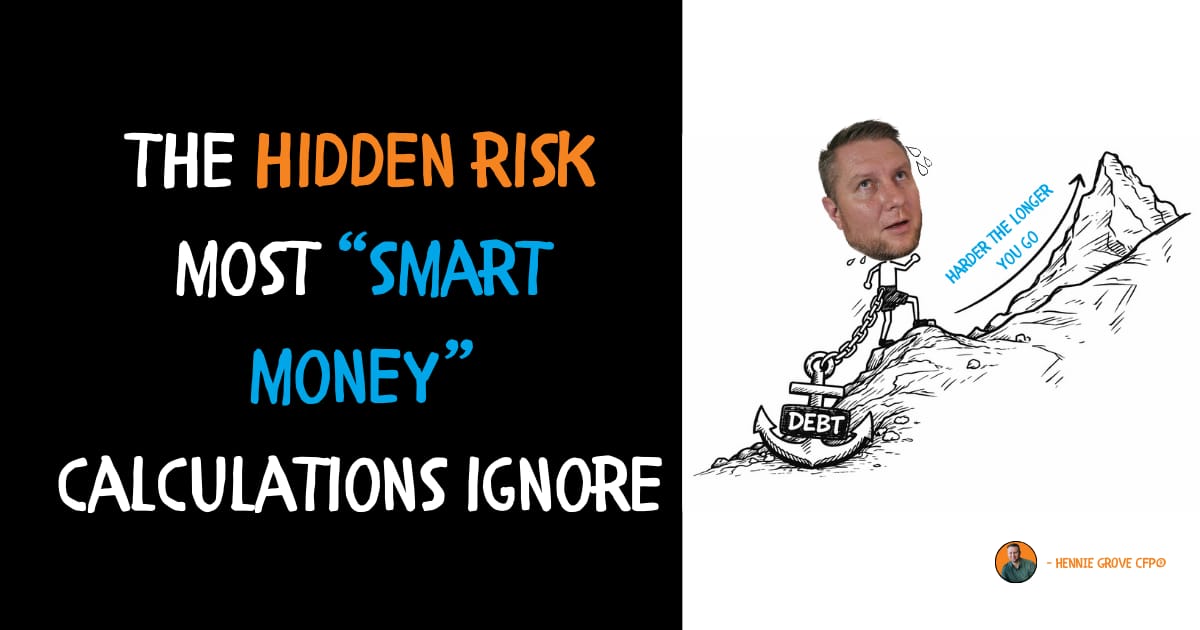
Think of it like climbing a mountain.
At the very bottom, there’s a heavy anchor lying on the ground. It’s a big one.
You step onto it.
For a moment, it feels like progress.
Standing on that giant anchor you’re suddenly higher than where you started.
It feels smart.
Like you’ve found a shortcut. A money Hack.
Like a win!
That’s what debt often feels like at the beginning.
But then the climb continues.
And now you’re not just climbing the mountain.
You’re dragging the anchor with you.
Every step higher makes the anchor feel heavier.
Every pause costs more energy.
Every slip is harder to recover from.
The anchor didn’t help you climb.
It only helped you start.
And the longer the climb, the more obvious the trade-off becomes.
This is where the “good debt versus bad debt” debate usually falls apart.
It assumes debt is a tool you can pick up and put down at will.
In reality, debt behaves more like snake handling.
You might know someone who’s done it for years without getting bitten.
They’ll happily explain how safe it is.
All snake handlers eventually get bitten.
The only variable is when.
Debt works the same way.
Debt doesn’t fail when things go right.
It fails when life does what life always does…
When you zoom out, this isn’t just a specific country issue – it’s a global pattern.
In the United States, household debt reached record levels in 2025, with total balances of roughly $18.6 trillion, and credit card debt alone exceeding $1.2 trillion.
Average household debt now sits well into six figures. Rising costs are increasingly being bridged with unsecured credit rather than higher incomes.
Where I currently live – in South Africa – recent data shows a similar pressure building. According to the latest Q4 2025 Debt Index from DebtBusters, consumers entering debt counselling are using around 71% of their take-home pay just to service debt. Among higher-income earners, that figure rises to roughly 85%.
No income group seems to be immune to bad money behaviour.
Across countries, currencies, and income levels, the pattern is the same.
People are working harder than ever, yet most of what they earn never really becomes theirs. Every cent flows straight through them – to banks and loan institutions in the form of interest, after they had to pay the Taxman first – leaving very little room to build resilience or optionality.
This is why debt feels so suffocating over time.
You’re running faster, but going nowhere.
The mountain doesn’t get smaller.
The anchor just gets heavier.
What clever debt arguments rarely mention is sleep.
Debt changes HOW you sleep.
It narrows how long you can go without income.
It makes small problems feel urgent.
It turns what are supposed to be inconveniences into major crises.
It turns choices into obligations.
It forces you to optimise for cash flow instead of opportunity.
That pressure doesn’t show up in spreadsheets.
It shows up at 2 a.m, when you’re lying there staring at the ceiling – hating a job while knowing you have to get up to go there in a few hours.
Amazing how well you see at night, isn’t it…
Money is largely behavioural.
And debt is a constant behavioural tax
Here’s the quiet part most people discover too late.
When you remove debt, wealth builds faster, not slower.
Not because returns magically improve.
But because efficiency does and because you drop the negative return tax (debt) you have to pay before you can do anything else.
Every cent gets a job.
Cash flow becomes flexible.
Decisions become calmer.
Risk becomes something you choose for investment growth and financial freedom, not something forced on you to take away your stuff.
Progress looks boring.
But it compounds cleanly.
If debt is a problem for you, the solution is rarely dramatic.
It usually starts with something deeply unsexy.
A humble budget.
Accounting for where every cent goes. This is scary for most people who have never done one.
Often followed by something very practical:
Cancel one subscription you don’t actually need or even use anymore
Redirect that money to your smallest debt
Pay it off as fast as possible
Then take that payment and roll it onto the next smallest debt
Repeat until you’re free
This approach is known as the debt snowball.
It works not because it’s clever.
It works because it’s behavioural and gives you quick wins you can build on. It gets on you on the journey to reclaiming your life and your wealth.
Money is a behaviour problem, masquerading as a pure math solution.
If you don’t know what the debt snowball is, stay tuned.
That usually means you’re ready to make changes, but haven’t yet been shown a workable path.
Debt doesn’t ruin people overnight.
It ruins them slowly, by assuming life will behave.
Life never does.
Until next time, stay calm - and if life has changed, let’s talk.

This newsletter is intended for educational and marketing purposes only with examples intended to simplify potentially complex scenarios. For full disclaimer, please see https://www.grofinsolutions.com/succeed-with-hennie-newsletter-disclaimer/